Saturday, December 27, 2008

Arranging the Furniture on the Titanic


You want to hope for something better than what you have right now, don’t you? Otherwise you wouldn’t be hoping. But then, you forget that you have it all right now anyway, and you don’t know it.
Anthony de Mello

I love setting intentions for the New Year. There’s something very satisfying about getting clear on where I’d like to see my life heading. I usually come up with a list of twenty or so intentions, such as “to live simply, laugh often, love deeply” or “to invest wisely, see my assets grow, and have a worry-free income of 5%.” When I look back at the previous year, I’m always amazed to see how many of these intentions have manifested—often in totally unexpected ways. I soon learned how important it is to be very specific in what I ask for. One year I forgot to mention that I wanted a year free from legal hassles. That was the year I got sued.

Recently I’ve taken a different approach to setting intentions. I’m more willing to let God, Source, or Spirit be in charge, rather than “me” trying to be in control of my life. I realize that I have no idea how spirit is meant to move through this body-mind. Who is to know if what the “little me” wants is for my highest good? All it wants is to avoid pain and find pleasure. Lately it has come down to one simple intention: to live each moment in present moment awareness—and let God take care of the rest.

I've also begun to question whether setting goals really takes us where we want to go in our personal lives. It works well for business, which is quantifiable, but does it work for finding something as abstract as happiness? There are three important things we often miss:

1) All goal setting is future-oriented—and there is no future. It is essentially an attempt to create a new and better dream for ourselves. If we do the steps in our plan, we believe that we’ll feel better, be more fulfilled and happy. But doing things to make the ego feel better is all happening within the dream of illusion. Because it is within the dream, we’ll inevitably experience the pain and suffering that comes along with it, no matter how successful our action plan is. We’ll have a few moments of feeling good, believing that “we” (our egos) have accomplished something. But then dissatisfaction will set in and we’ll go on to the next thing to accomplish, and the next, all towards some impossible end when all our goals are satisfied. But there is no end.

Fulfilling our goals can at the most bring short-term happiness (otherwise, why would we need to go on to the next one?). We have to ask what it is that we really want, beyond satisfying our desires. What if we were to turn our attention inward to finding happiness that doesn’t come and go, and fulfillment where there is nothing that needs to be filled? The first step is going beyond the illusion that there is something out there in the future that will make us happy.

As Eckhart Tolle says, “The joy of Being, which is the only true happiness, cannot come to you through any form, possession, achievement, person, or event—through anything that happens. That joy cannot come to you—ever. It emanates from the formless dimension within you, from consciousness itself and thus is one with who you are.”

2) Most intention setting is based on the fundamental assumption that there is something wrong with me, and I have to somehow “fix” it. For whatever reasons, I am not enough just the way I am—because if I was enough, what would there be to “fix”? Working with intentions distracts us from the realization that we already are whole and complete.

Can you conceive of the radical thought that right in this moment there is absolutely nothing missing in your life?

The mind will immediately say, “No, no that’s not possible! I need to be a better husband, I need to be more surrendered, I need to inspire others.” But what if there was absolutely nothing missing in your life right now? Where would that leave you? You’d have to let go of all your dreams about the future and realize that right now is all there is.

As Alan Cohen says, “You are not a black hole that needs to be filled; you are a light that needs to be shined. The days of self-improvement are gone, and the era of self-affirmation is upon us. It is time to quit improving yourself and start living.”

3) No matter how many action steps you take, no matter how many goals you set, how many values you identify, you’re still trying to patch up the ego—and the ego, by its very nature, is unfixable. It’s the job of the ego to be dissatisfied and always want more. Trying to fix the ego is like trying to plug the holes in a sinking ship. The boat is eventually going to sink. The question is—are you willing to jump off the boat and be free?

If you were “enough,” if you had no fear, and you were living in the fullness of who you are, would you need an action plan? Does someone like Eckhart Tolle live his life from an action plan? I doubt it. From that place of being fully present, you would know that in every moment you were doing exactly what you needed to be doing, that your life was being revealed in exquisite perfection from moment to moment.

What if your 2009 action plan was not to have a plan—other than to offer love now—and trust that your life is unfolding perfectly just as it is?

David Deida speaks to this when he says, “Enlightenment is the capacity to open and be lived by the love that is already, miraculously, living your life, despite all your current torment and refusal. Instant enlightenment is to offer love now—whatever the circumstance—without waiting for things to get better.”

Setting goals can be helpful in this difficult world, even if it is rearranging the furniture on the deck of the Titanic as it sinks slowly into the silent sea. We might as well enjoy the ride. Action plans, workshops and self-help books help us to feel good about ourselves. But they will never bring us the happiness we are looking for. That’s because we are creating our goals using the conditioned mind—the mind that feels it needs to find solutions and come up with strategies to solve its problems. It asks all the wrong questions, based on likes and dislikes, the past and the future, and avoidance of pain.

To go beyond conditioned mind to clear mind, it helps to enter into a process of self inquiry, asking the question, “Who is it that wants to make goals?” or “What is it that needs to be renewed”? Until we are willing to drop into that place of “not-knowing” that these questions lead to, achieving every goal on our list will not bring us inner peace. That can only come through unconditional awareness, where we don’t need anything and there’s nowhere further to go. That doesn’t mean we don’t do anything with our lives, it just means that there is no longer anyone there “doing” it.

Having said all this, I'm still having fun setting intentions for the New Year—though I'm less attached to the results.


Friday, November 14, 2008

When Bodies Break Down


To identify oneself with the body and yet to seek happiness is like attempting to cross a river on the back of an alligator. Ramana Maharshi

After a week-long trip to Washington, DC, I come back to Hawaii with a cold, a nagging cough, and a body that feels like it’s been run over by a truck. My eyes are burning, my brain is in a fog, and all I want to do is climb into bed and sleep. When I finally do sleep, I wake up just as tired as before.

This fatigue is nothing new. Recently I found out that I have parasites, and may have been carrying them for twenty years. I did one of those unpleasant treatments, which is worse than the disease. Just yesterday I found out that the treatment didn’t work, and not only that, the parasites are even more active! No wonder I’m so tired all the time. Together with a minor squamous cell surgery that is not healing, and the continuing existence of prostate cancer cells in my body, I feel like one of those old rust-bucket cars, where the muffler falls off, and as soon as you fix that, then the transmission goes.

One of the side effects of getting older is that the body seems to break down with alarming frequency.

I love what Robert Adams, a spiritual teacher, said. This was when he was ill with Parkinson’s disease, and shortly before his death in 2004: “I want to let you in on a little secret. There are no problems. There never were any problems, there are no problems today, and there never will be any problems. Problems just mean the world isn’t turning out the way you want it to.”

The challenge, as always, is how to be OK when things are not going the way you’d like them to.

What can we do?

1. Accept that this is what is happening. We’ll find ourselves a lot more peaceful if we can say, “OK, this is what is happening. If I fight it or struggle against it, it will only create more suffering.

2. We can also say, “I have a preference that things would be different, but this is what is. Right here, right now, in this moment, all is well. Behind my discomfort there is a peace that is unchanging. If I can be still for an instant, it is there.”

3. We can take whatever steps are necessary to take care of things. I can see my doctor about another way of getting rid of the parasites; I can work more on an anti-cancer diet; I can be grateful for the love that is present in my life in every moment.

Tuesday, October 28, 2008

Pema Chodron


Sometimes I have trouble with the Buddhist teachings, especially when they get into the Eight Worldly Dharmas, the Six Kinds of Loneliness, the Six Paramitas and all that stuff. But, after some resistance, I became totally absorbed in Pema Chodron's book When Things Fall Apart: Heart Advice for Difficult Times. Here are a few quotes that lit me up.

To be fully alive, fully human, and completely awake is to be continually thrown out of the nest. To live fully is to be always in no-man’s land, to experience each moment as completely new and fresh.

The process of becoming unstuck quires tremendous bravery, because basically we are completely changing our way of perceiving reality, like changing our DNA.

Without giving up hope—that there’s somewhere better to be, that there’s someone better to be—we will never relax with where we are or who we are.

We can’t attain enlightenment, let alone feel contentment and joy, without seeing who we are and what we do, without seeing our patterns and our habits . . . it’s a process by which self-deception becomes so skillfully and compassionately exposed that there’s no mask that can hide us anymore.

The middle way is wide open, but it's tough going, because it goes against the grain of an ancient neurotic pattern that we all share. When we feel lonely, when we feel hopeless, what we want to do is move to the right or left. We don't want to sit and feel what we feel. We don't want to go through the detox. Yet the middle way encourages us to do just that. It encourages us to awaken the bravery that exists in everyone without exception, including you and me.

Friday, October 10, 2008

New Beginnings

Day 27
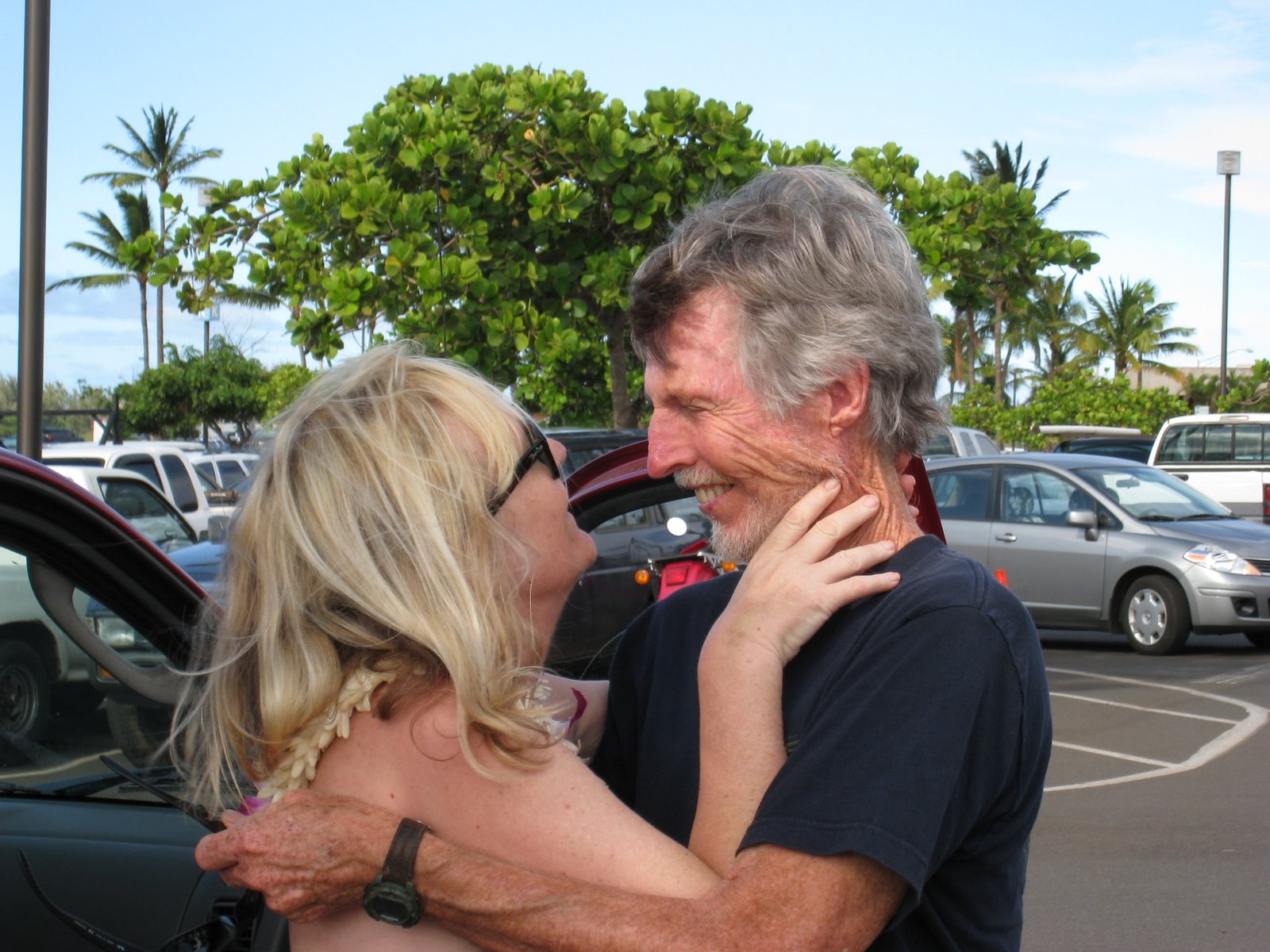
I’m not prepared for what I see when Linda walks into the terminal. She looks young, radiant, and glowing. We hug each other passionately. “You’re not going to believe it,” she says, looking at me with eyes of love. “I’m a different person. I've been reborn.”

"I can see that," I say, placing a sweet-smelling lei around her neck. "It's so clear."

This marks the beginning of a new life for both of us.

And it all started with a simple intention of doing a month-long retreat.

Doing the Work

There comes a time in the affairs of man when he must take the bull by the tail and face the situation. W.C. Fields

Day 26
When Linda calls, I can’t believe she's the same person who left a few days ago. There’s a new aliveness and strength coming through her voice, like someone who has woken up from a long nightmare to finds themselves fully and joyfully alive. What a courageous journey she's been on. She'll be home in less than twenty-four hours.

Without my usual social interactions during the retreat, I’m noticing that when I talk to people, that I smile a lot. Nothing wrong with that, but at some point the smile becomes forced. I can even feel the muscles of my face tighten when it happens. I remember David Deida, an old friend, saying, “Peter, I often see you smile when you’re not feeling like smiling. It’s not authentic. What is it that you’re hiding?”

I have a session with David and Tom, my two therapists, and tell them about my compulsive need to smile. “It’s your way of coping.” Tom says. “You try and please everyone by being nice.”

“Yeah,” I say. “Smiling is my way of keeping everything on the surface, so I don’t have to show any emotions. I can keep everyone at a distance. It’s like skippping a stone across the surface of a pond."

David says, “So, this is a chance for you to be more serious than you take yourself to be.”

“That’s so true. If I was serious, friends would see who I really am - a frightened little child that feels completely worthless, I'm terrified that they'd abandon me.”

Tom hands out one of his helpful little lifelines: “Be gentle with yourself. Your friends clearly see who you are—a kind, loving person."

I love these guys.

A thought pops to mind. “I also smile so that I can avoid confrontation of any kind. I’m terrified of strong, aggressive men. I couldn’t stand to be in the same room with someone like Donald Trump or Vince Vaughan.” Heat courses through my belly. “Wow, there’s so much rage in there!”

“What would it be like to let that masculine side out more?” David asks. “What if you could let more feelings come through—anger when you’re angry, sadness when you’re sad, without being afraid it will overwhelm you?”

“That would feel so good.”

“And you can be the curious observer, watching it all,” Tom adds.

It’s hard to believe that I’m still dealing with the “wounded child” at my age. But if it helps me open my heart and be authentic, I don’t care if I’m a hundred years old and still doing this stuff. It’s not done until it’s done. Ya gotta do the work, baby.

Friday, October 3, 2008

Renewal

Day 21
Clare calls from the Ibogaine Clinic to tell me that Linda has gotten through her first treatment with an A+. There were two doctors with her the whole time. A number of people have died while taking ibogaine and they take every precaution.

I’ve had my phone on “silent” for the retreat, but recently turned it on to make sure I didn’t miss a call from Linda if she needed me. The phone rings and it's my dear friend Christine calling from New Mexico, saying that she and Kenn will be visiting Maui in November. What wonderful news. Once I feel complete in myself, the people I love most in my life seem to be miraculously showing up all around me.

Linda calls. It's like talking to a completely different person - clear, strong, and at peace with herself. What a huge step this is. Of all things, she met with a naturopath today and enjoyed it. She’s even eating real food (instead of caffeine and sugar). She's tired after the treatment, but tells me that she went to a place where constellations of stars rearranged themselves into form. "I came away with a deep acceptance of what is," she says. "It was like my brain was reset to the clarity and innocence of a six-year-old. And I don't have any craving for the pain meds." It's almost too much to believe.

The Core of Life

Let’s remember why we’re here at retreat: for the amazing opportunity to really look into the core of our existence, the core of life itself that is so easy to overlook. It’s not easy to pay attention to it, because it’s not noisy and it’s not clamoring for attention like all other aspects of the human mind. Adyashanti

Day 20

With Linda gone, I'm sure that my fear of abandonment will show itself. I've been haunted by this fear ever since my mother died when I was twelve. The frightened child in me believes that if someone is not physically present, they might just as well be dead. That was my experience as a boy when I was told to “get over it” after my mother disappeared off the face of the earth. No one in the family ever spoke of her again; photos were hidden away; any sign of her was eradicated. In my twenties, this fear left me suicidal when I went to live alone in Paris, leaving behind friends and family. Unable to make friends and not knowing the language, I spiraled into depression. Since then I‘ve been afraid that if I was left alone again, the depression would come back to devour me.

Now I have the chance to sit with my aloneness. Since I'm on retreat, I don't want to take any easy outs - calling a friend or distracting myself on the computer. I sit quietly on the lanai, watching the thoughts float up to the surface. How interesting, there's the thought, "Where is Linda now? I'm on my own. No one even knows I'm here. Maybe I should call someone . . ." Much to my surprise, the thoughts come up and drift away; they no longer have any charge. Inside of experiencing emptiness, I'm experiencing fullness. What was once an “empty hole” needing to be constantly filled is now whole and complete. It is my own Self . . . the gift of retreat.